Improving Eco-certifications
Eco-certifications aim to increase the demand for sustainable seafood and, in turn, create market incentives to improve fisheries and aquaculture practices.
These market efforts are now big business. The global retail value of eco-certified seafood was estimated to be worth $11.5 billion U.S. in 2015.
The Stewardship Councils in Canada
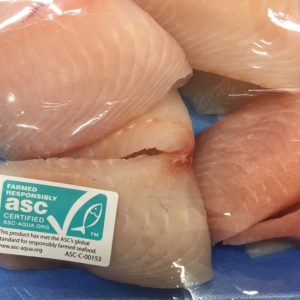
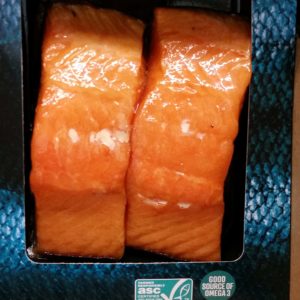
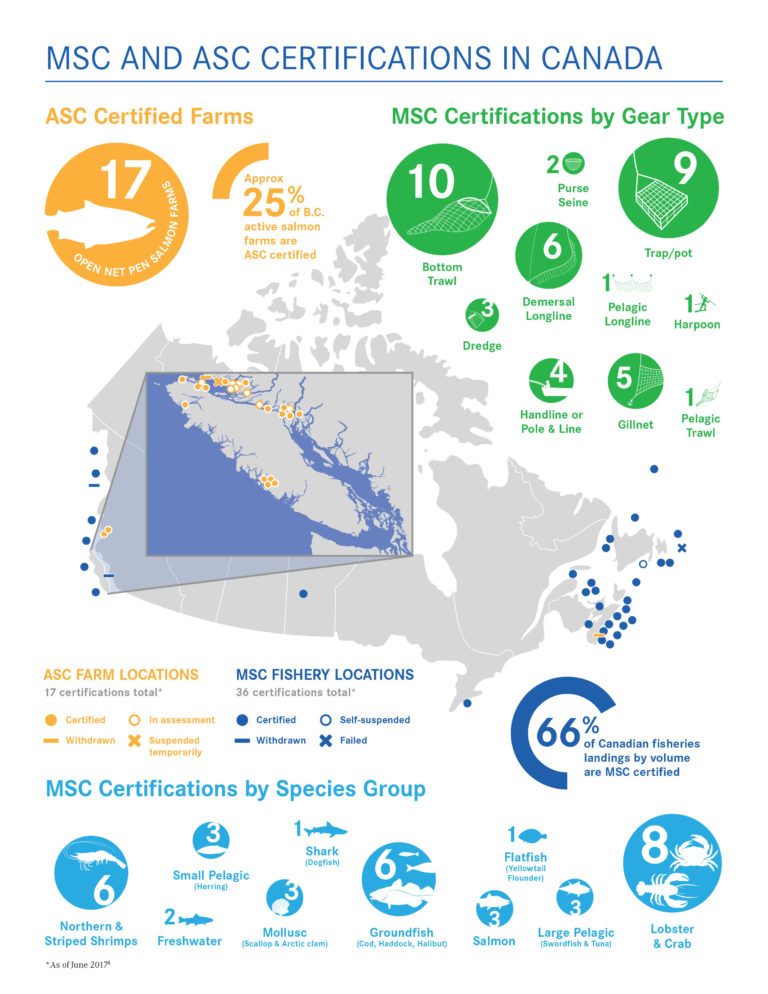
The Marine Stewardship Council (MSC), the most prominent global certification program for wild fisheries, has been in Canada for a decade. Over two-thirds of the country’s fisheries’ landings are now certified to carry the eco-label. The Aquaculture Stewardship Council (ASC), a newer, complementary aquaculture certification program, has been in Canada for two years and has certified a growing number of salmon farms.
MSC: Since 2008, 36 MSC certifications have been granted in Canada covering 80 per cent of fisheries landings by value, and 66 per cent of landings by volume.
ASC: As of October 2018, more than 25 farms are ASC certified representing around half of B.C. production volume. The B.C. salmon farming industry has committed to 100 per cent ASC certification by 2020.
Our Work to Improve Eco-certifications
SeaChoice is committed to keeping MSC and ASC Standards at a level that ultimately leads to real changes on the water, and reduces the environmental impact of fishing and aquaculture. Here is how:
Report: What’s Behind the Label?
In September 2017, SeaChoice released the first review of all Canadian MSC and ASC certifications.  The report examines if, and how, these certifications are contributing to improving the environmental sustainability of Canadian fisheries and aquaculture practices.
Report: Global Review of ASC’s Salmon Standard
In October 2018, SeaChoice released the first global review of all ASC salmon farm certifications. The report examines both the conformance and performance of farms with the Salmon Standard, as well as the changes being made to the Standard and assesses the impact of those changes
Advisory Boards and Committees
SeaChoice’s partner organizations have been members of MSC’s advisory boards over the years, and currently participate in many ongoing policy and standard improvement processes. As a follow-up to our 2017 review report, SeaChoice continues to work with MSC and other global stakeholders in the system, to address key changes that need to be made to the standard, process, and governance of the MSC eco-certification.
SeaChoice is committed to keeping MSC and ASC Standards at a level that ultimately leads to real changes on the water, and reduces the environmental impact of fishing and aquaculture.
Our partner organizations were steering committee participants during the Salmon Aquaculture Dialogue, which established the initial ASC Salmon Standard. We ensured the Standard focused on measuring performance with farm-level metrics that would reflect a fair and unequivocal assessment of environmental sustainability. We worked for a transparent and inclusive process to allow stakeholder input into the certification process and subsequent monitoring. Partner organization members currently sit on the ASC Technical Advisory Board, as well as the sea lice and parasiticide use Technical Working Group.
Standard and Audit Submissions
SeaChoice and our partner organizations have been stakeholders in Canadian seafood certifications for over a decade, participating in 74 per cent of all MSC certifications and 88 per cent of ASC certifications. As stakeholders, we aim to ensure the correct and most up-to-date information about fisheries and farms is used by the certifying assessment teams, and that the MSC and ASC standards are being rigorously and consistently applied, so consumers can trust these labels.